Power is often treated like a problem to solve. Something to flatten, give away, or tiptoe around.
In many equity and inclusion spaces, the instinct is to move toward shared leadership—and
for good reason. The traditional model of centralized, top-down control
has left many people out, especially those who’ve been historically
marginalized. Shared leadership offers an alternative: distribute
decision-making, center collaboration, and blur hierarchy.
And while I appreciate what shared leadership intends, I also think we need to be more honest about what power actually is.
Power doesn’t disappear just because we “share” it. It doesn’t become
less complicated just because we’re more collaborative. And pretending
it does often causes more harm than good.
What if power isn’t the problem?
And what if, instead of flattening power, we learned how to hold it
with intention, align it with our values, and use it in service of
belonging and transformation?
When I facilitate, consult, or support a team, I hold power. I
influence the space and guide the process. People look to me for cues,
but I don’t try to erase that. I name it. I try to use it with care
and not control. And I try to create space where others can step into
their own power in ways that serve connection, not competition.
Using my power is about creating a center that holds all of us.
This kind of power isn’t loud or dominating. It’s quiet, intentional,
and relational. And it’s built on a few key ideas that go beyond the
usual frame of shared leadership.
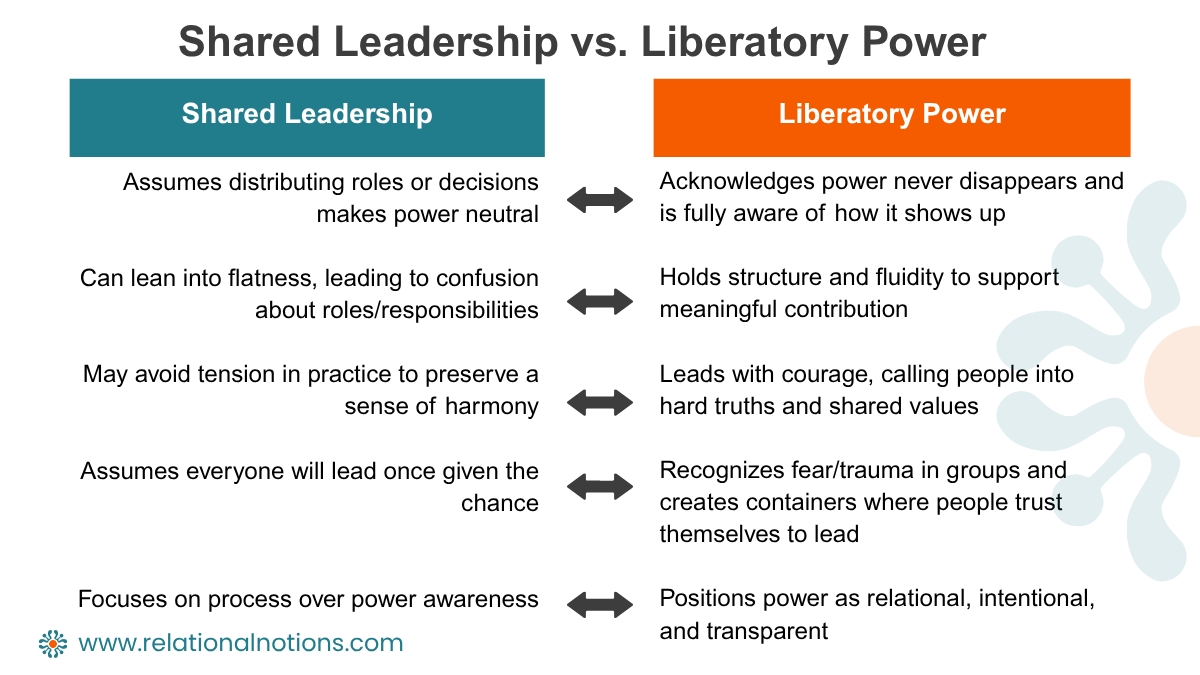
1. I don’t pretend power disappears.
Shared leadership often assumes that once we spread roles or share
decisions, power becomes neutral. But power still shows up in voices
that are louder, in unspoken influence, and in who gets listened to.
✨ I name power. I track how it moves. And I invite others to do the same.
2. I hold structure and fluidity.
Shared leadership sometimes leans so far into flatness that people
are left confused about who’s doing what or whether anything’s getting
done at all. I believe structure is not the enemy. When it’s
values-aligned, it’s a tool for co-creation and liberation.
✨ Leadership is about creating containers where people feel safe and free enough to contribute meaningfully.
3. I believe in courageous leadership.
Many shared leadership models avoid tension. But I don’t believe care
and challenge are opposites. I believe in calling people into their
values, the hard truths, and the deeper work.
✨ We all lead. And we all have a responsibility to lead bravely.
4. I don’t pretend collectivity is easy.
Real groups carry fear, silence, trauma, and protection. Just saying
“we all lead” doesn’t mean people feel safe enough to show up. I build
conditions for people to move from self-protection into participation
and I hold the pace with them.
✨ I don’t flatten leadership into a performance of inclusion.
Instead, I dive deep to understand what people need to trust themselves
enough to participate.
When reimagined, power becomes:
-
An Invitation.
To speak, to shape, to be seen.
-
An Alignment.
Between what we say matters, and how we actually move.
-
A Responsibility.
To use our voice, access, and insight in service of equity and belonging.
-
A Co-Creation.
Where structure helps us move forward together.
For Me, This Is What Power Means:
It’s not about being less visible.
It’s not about pretending everyone has the same influence.
It’s not about diluting leadership so no one feels uncomfortable.
It’s about using whatever power I hold with care, transparency, and
with deep accountability to the people I serve, the values I hold, and
the kind of world I want to help build.
Power doesn’t have to be flattened.
It can be held and shared with clarity.
And it can be practiced with generosity, courage, and trust.
An Invitation to Reflect:
Let’s not run from power. Let’s use it, reimagine it, and hold it in ways that set more people free.